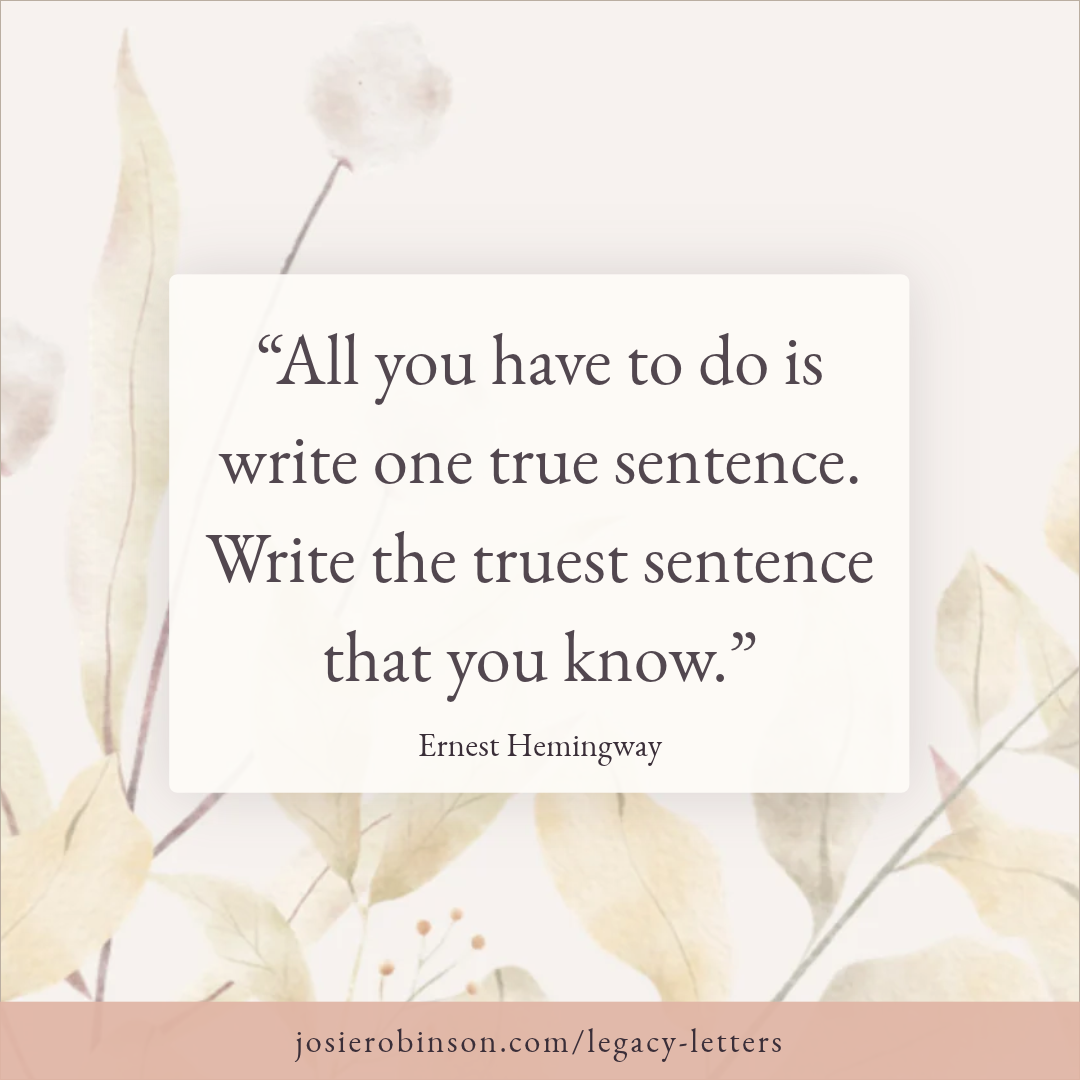
Before I say anything else about how to write a letter to someone you love who is dying, I want to tell you this:
You don’t have to be a writer.
You don’t have to say everything.
You don’t need the “perfect” words.
One true sentence is enough.
All you need is a voice. Your voice.
As long as you have that, you can write this letter.
If you’ve searched for how to write a letter to someone who is dying, you’re probably sitting somewhere specific right now.
A hospital waiting room. A parent’s kitchen. The parking lot outside a memory care facility. Your bed in the middle of the night after a very long day.
You can feel the window closing, and you want to say something before it does.
Whether it’s a letter to a dying mother or father, a partner, a sibling, or a dear friend. The practice is the same.
And I’m so sorry that you’re here, reading this.
But I’m so glad you’re here, writing this.
You’ve already done the hardest thing
The hardest part of this letter is not the writing. It’s deciding to write it in the first place.
If you’re reading this right now, you’ve done that part. You found this post because you were searching for it.
What comes next is just one sentence at a time, and I’ll walk you through it.
So here’s what I want you to do first. Get a pen or pencil.
Grab whatever spare paper you have lying around, the notes app on your phone, a post-it note, anything.
You are not drafting a eulogy. You are not writing an obituary. You are writing a letter to someone you love.
The way you’d talk to them if you were sitting together at the kitchen table.
In your own voice.
This is the most important thing I’ll tell you in this whole post. Write it the way you actually talk.
Not your professional voice. Not your public speaking voice. Not the formal, fancy voice you think you’re supposed to use.
Your real voice.
The one the people who know you and love you will instantly recognize.
How to start your letter
The thing I hear most from people sitting down to write one of these letters is: how do I even start this? I don’t know where to begin.
Here’s a simple sentence starter to help:
I’m writing this to you because ___.
Fill in the blank with the way you would actually speak to that person if they were in the room with you right now.
Think about what you most want to say to them before they leave.
All that matters is that it’s in your voice and that it’s honest. That’s it.
You could write something like:
“I’m writing this to you because I love you.”
“I’m writing this to you because I want you to know how important you are to me and how much you’ve helped me.”
“I’m writing this to you because there are things I haven’t said yet.”
If you write nothing else, a single sentence like one of these is already a gift to the person you give this letter to.
Everything beyond that is a bonus.
5 simple sentence starters to help you write more
When you’re ready to write more, try one or two of these sentence starters.
You don’t have to try all of them, unless you want to.
Pick the ones that feel most important to you. The ones your gut tells you are the right ones. The ones that make you feel something when you read them.
If they make you feel something, they will make your person feel it, too.
What I want you to know is…
Thank you for…
I’m sorry for…
The thing I’ve never said out loud is…
If I could leave you with one thing, it would be…
One line for each is enough. You can go longer if the words keep coming.
If the words stop, or you feel overwhelmed, stop. Come back tomorrow, or another day.
This isn’t a race, even when it feels like one.
This practice is as much for you as it is for them.
Why this helps (according to research)
There’s a practice in palliative care called dignity therapy, developed by Dr. Harvey Chochinov, a researcher in Canada.
For over twenty years, Chochinov and his team have sat with dying patients and helped them write down what they most want their loved ones to know. The result is what they call a generativity document.
A letter, basically.
Some clinicians call it a dignity therapy letter. I call it a legacy letter.
The research on this, though, is remarkable.
Patients in these studies who wrote one of these letters at the end of their life reported a greater sense of dignity, purpose, and meaning in their final weeks.
Almost all of them said it was one of the most important things they ever did.
Families who received one held onto it for years. Often decades.
They said it helped them process their grief after their person was gone.
Almost every family member who received one said they would recommend everyone do this.
Now here’s the thing. The dignity therapy research is about dying people writing letters to the ones they love.
You are doing the opposite. You are writing TO someone who is dying, not from them.
But the practice does the same work either way. Because what’s underneath all of it is the same thing.
In the grief world, there’s a name for it.
Unfinished business.
Unfinished business is the stuff that doesn’t get said before someone dies.
The thank yous that never came. The apologies that stayed held in. The I love yous we always thought there would be more time for. The questions we never got to ask.
It’s one of the hardest things grievers carry. It can hurt for years.
Sometimes forever.
Writing a letter, before someone dies, is one of the simplest and most powerful ways to put that business to rest.
For them, and for you. For anyone else in your family who needs to hear what you have to say.
This isn’t just a nice idea. It is one of the most researched end-of-life practices we have.
And it helps.
You don’t need a palliative care team to do it. You just need a pen and some paper and the willingness to begin.
And if you’re still reading this, you are.
5 things NOT to do when writing this letter
I’ve sat with a lot of grieving families. And I’ve watched people get stuck worrying about doing this wrong. Here are five things you can let go of.
1) Don’t wait for the perfect words.
They are not coming.
The perfect words are a trick your mind plays to keep you from writing the real ones.
The real words are the ones you have right now.
2) Don’t apologize for crying while writing.
The tears are not a sign you’re doing it wrong. They are a sign you’re doing it right.
3) Don’t reread it a hundred times to make it sound smart.
This letter is not being graded by anyone. It’s not going on social media. It’s a private letter for the person you love.
4) Don’t wait until they can’t respond to write it.
If they are still here and still able to read, let them read it now.
So many of the families I sit with wish they had given the letter while there was still time.
5) Don’t feel like you have to say every single thing.
It’s impossible to fit a whole relationship on a page.
The letter is not the sum of your love. It’s a piece of it that they can hold in their hands and read when they need it most.
What if they are already gone?
Some of you are reading this looking for how to write a letter after the person has already died.
If that’s you, if the window already closed and you didn’t get to say what you needed to, I want you to know something.
You can still write this letter.
Write it to them.
Grief counselors have a name for this practice. The unsent letter. It is one of the most healing things you can do.
The writing is for both of you. It always was.
Here is something else I want you to know about why you should write this letter.
Death does not end a relationship. It changes it.
The grief world has a name for this too.
Continuing bonds.
It is the idea that the person you lost is not just gone. They are still part of your life. Just in a different shape than before.
The relationship continues through memory. Through the things they taught you. Through the signs you see that make you stop and think of them.
And through writing. Especially through writing.
Writing a letter to someone you have lost keeps the love moving forward.
It gives you a place to put what you are carrying.
It gives you a place to hear back from them, even when they can’t speak anymore.
The people who write, before or after loss, are the ones who keep the love moving from one generation to the next.
If you want help with this
If you need help doing this, I built Legacy Letters to make it as easy as possible. You’ll get the structure. The prompts for every section. The design of the final letter.
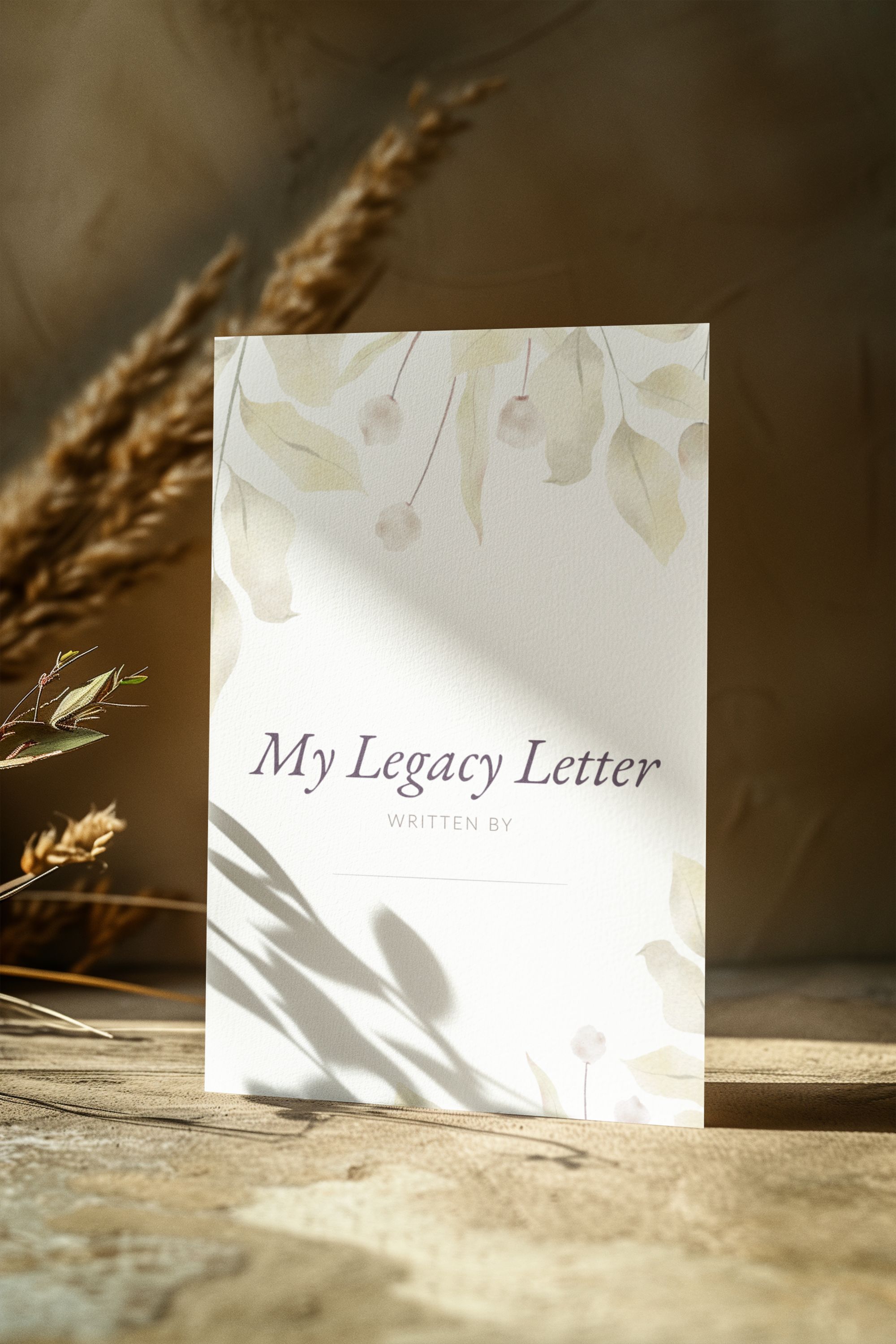
Legacy Letters
A self-paced course and printable keepsake letter book
You just show up with your pen, answer the prompts in your own words, and at the end you’ll have a beautiful fillable PDF you can print out, hold in your own hands, and share with the people you love.
That’s it. No blank page staring back at you. No wondering what to write next. No worrying about how to put it together or make it pretty.
I’ve got you.